History of PLM posters, 1880-1938: the company that invented the modern travel poster
The complete story of the Paris-Lyon-Méditerranée railway company and the poster artists who defined the grammar of French poster art between 1880 and 1938. Hugo d’Alesi, Roger Broders, Cassandre, Albert Brenet.

Key points
- 60 posters in the French Riviera posters collection, the 20 from this article in the table below.
- From 17,80 € in A4, up to 69,37 € in A0, 5 sizes for each poster.
- Printed in Europe on demand, free delivery from 59 €.
The table
The 20 posters at a glance


The Paris-Lyon-Méditerranée railway company, founded in 1857, left its mark on the history of French poster art between 1880 and 1938. 5,000 posters commissioned, dozens of illustrators enlisted, and a single goal: to make Parisians dream of the French Riviera, the Alps and Provence.
From Henri Tanconville to the first Art Deco illustrators, and through Roger Broders, who would sign the majority of them in the 1920s and 1930s, the PLM company defined what we would today call a strong graphic identity: verticality, saturated palettes, stylized landscapes, monumental typography.
Our catalog pays tribute to this legacy. See our mountain posters, French Riviera or Provence posters, directly inspired by the PLM originals.
The PLM, a railway company that made graphic design history
If you love French Riviera or Alpine posters, you are probably looking, without knowing it, at the legacy of a single railway company, the PLM. Between 1880 and 1938, the Compagnie des Chemins de fer de Paris à Lyon et à la Méditerranée produced the largest series of travel posters ever created. More than 500 signed posters, and a visual grammar that still defines what we call the aesthetic of French posters today.
Here is the story of this company, the illustrators who signed its posters, and the graphic revolution that unfolded in its studios between the 2 wars.
1857-1880, the birth of the company that would link Paris to the Mediterranean
The Compagnie des Chemins de fer de Paris à Lyon et à la Méditerranée was born in 1857 from the merger of 3 older companies. Its network then covered the southeastern quarter of France. Its flagship line, Paris-Lyon-Marseille, would become the most profitable in Europe by the turn of the century, driven by seaside tourism on the French Riviera and spa tourism in the Massif Central.
At first, the PLM communicated soberly, with dull typographic posters and timetables pasted up in stations. But from the 1880s on, it understood that to fill its trains, it had to make people dream. It commissioned the first color illustrations from professional poster artists.
1880-1914, the age of pioneers (Hugo d’Alesi and Frédéric Hugo d’Alesi)
The first great PLM poster artist was Frédéric Hugo d’Alesi (1849-1906). A Romanian based in Paris, between 1885 and 1905 he signed several hundred posters for the PLM, but also for the Compagnie de l’Est and the Chemins de fer du Nord. His style drew on Orientalism and realism, with detailed landscapes, costumed figures and natural colors.
D’Alesi is the archetype of the Belle Époque poster artist. His French Riviera posters (Hyères 1908, Cannes 1900, Monaco 1895) already announce the grammar that Roger Broders would perfect 20 years later: a sweeping view over the bay, palm trees in silhouette, a human figure in costume.
After his death in 1906, the PLM continued to commission posters from dozens of illustrators (Misti, Henri Tanconville, Géo Dorival), but the visual identity remained fragmented. It would take until 1922 for a single illustrator to unify the grammar.

1922-1932: the Roger Broders era
In 1922, the PLM signed a near-exclusive contract with Roger Broders. Over 10 years, he drew around 100 posters that defined the modern PLM identity. To understand what Broders specifically brought to the table, see our full article on Roger Broders, the illustrator who made 1920s France shine.
What defines the Broders era is a unified palette (terracotta, ochre, deep blue), simplified forms (stylized flat color, soft geometry), and a figure placed as an invitation into the scene. The traveler looks out at the landscape with their back to us, and we project ourselves into them.
The signature destinations of the Broders era
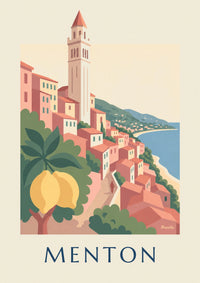
The Mediterranean French Riviera. Cassis, Bandol, La Ciotat, Sainte-Maxime, Saint-Raphaël, Antibes, Monaco, Menton. More than 30 dedicated posters between 1925 and 1932. This is Broders’ signature territory and the one that left the deepest mark on the collective imagination.
The winter French Alps. Chamonix, La Clusaz, Megève, Saint-Gervais. About 20 posters that helped democratize pre-war skiing. Slender figures in jacquard sweaters, stylized glaciers, glacier-violet light.
Provence and the Camargue. Avignon, Aix, Les Baux, Arles, Les Saintes-Maries-de-la-Mer. About 10 posters that stage the tourist Provence of the 1920s, before mass tourism.

1925-1938: the other PLM school (Roger de Valerio, Pierre Commarmond, Albert Brenet)
Roger de Valerio, the elegant one
While Broders was signing his French Riviera posters, Roger de Valerio (1886-1951) was creating more fashionable, sporting and maritime posters for the PLM. His style is more realistic, his figures more slender. He designed posters for the horse races in Cannes, the regattas in Monaco and the casinos of the French Riviera.
Pierre Commarmond, the Savoyard
Pierre Commarmond (1897-1983) mainly designed Alpine posters for the PLM (Megève, Chamonix, La Clusaz). His palette is bolder and his figures more dynamic than Broders’. He represents the other side of the PLM Alpine poster.
Albert Brenet, the seafarer
Albert Brenet (1903-2005) created the last generation of PLM posters before the merger into the SNCF in 1938. A specialist in maritime posters (ocean liners, Mediterranean cruises for the Compagnie Paquet, linked to the PLM), his style already foreshadows the post-war years.

1938: the end of the PLM and the birth of the SNCF
On January 1, 1938, the 5 major private French railway companies (PLM, Nord, Est, État, Paris-Orléans) were nationalized and merged into the SNCF. The PLM disappeared administratively, but its posters continued to be printed for a few more years out of habit.
The new SNCF inherited hundreds of PLM lithographic plates, which it used until the 1950s. Many so-called PLM posters in today’s tourist shops are in fact late SNCF reprints, which explains their vague dating.

Why the PLM grammar still dominates the poster
Nearly a century after the company’s disappearance, the PLM grammar continues to shape everything we now call the French poster.
Flat color. Inherited from commercial lithography, flat color remains the visual signature of the poster. No photographic gradients, no complex textures, just broad areas of saturated color.
The terracotta and midnight blue palette. The PLM palette (terracotta, ochre, deep blue, olive green, cream) remains the most imitated. You find it on home decor magazine covers, artisanal product packaging and tourist shop windows.
The figure as an invitation into the scene. The technique of showing a figure from behind, gazing at the landscape, is still widely used by contemporary illustrators who follow in Broders’ footsteps.

Bring the PLM spirit into your home
The PLM aesthetic suits 3 types of interiors especially well.
Parisian Haussmann apartments. High walls (3 m+) can carry A1 or A2 landscape posters. Choose a vertical format for destinations with strong verticality (Mont Saint-Michel, the Eiffel Tower) or a horizontal one for Mediterranean panoramas (Cassis, Bandol).
Provençal houses and Mediterranean villas. Exposed stone walls or ochre plaster pair beautifully with the PLM palette. Design a wall of 3 to 5 posters around your home region or the place you love.
Modern Scandinavian interiors. The contrast between light-wood Scandinavian minimalism and the rich color of the PLM style creates a striking visual tension. Go for a single large A1 on a light wall, with a stylized subject.

Discover the PLM destinations as Brunelia posters
All of our Mediterranean city collections follow the PLM grammar. Cassis, Bandol, La Ciotat, French Riviera, Provence, Marseille: each poster is drawn in direct descent from the great PLM poster artists, with a terracotta and deep blue palette, stylized figures and soft geometry.
To learn more about the illustrators themselves, read Roger Broders and Cassandre.
To prepare your order, check the dimensions on the page of the poster you’ve chosen, as well as our shipping policy and our return policy.

Build this wall
3 posters from this article, at true scale


All 3 posters: 99,02 €
Frequently asked questions
You often ask us
What is the PLM?
The Compagnie des Chemins de fer de Paris à Lyon et à la Méditerranée (PLM), founded in 1857, operated the railway network of the southeastern quarter of France until it was nationalized and merged into the SNCF in 1938. Its advertising department produced more than 500 travel posters between 1880 and 1938.
Which illustrators created posters for the PLM?
Hugo d’Alesi (1880-1906), Misti, Henri Tanconville, Géo Dorival, and above all Roger Broders (1922-1932), Roger de Valerio, Pierre Commarmond and Albert Brenet (1925-1938). Roger Broders remains the most emblematic, with around 100 French Riviera posters.
What is the characteristic palette of PLM posters?
Terracotta, ochre, deep blue (almost matte), olive green and cream. Never a bright turquoise, never a saturated yellow. This terracotta and midnight blue palette defines the DNA of the French poster.
How much are original PLM posters worth?
From €500 to €25,000 depending on the illustrator, the year, the condition and the rarity. Broders posters from 1925-1932 (Cassis, Bandol, La Ciotat) regularly reach €5,000 to €15,000. Major pieces such as Cassandre’s “Normandie” climb as high as €80,000.
Why does the PLM grammar still influence the poster today?
Flat color, the terracotta and deep blue palette, the figure seen from behind as an invitation into the scene, and soft geometry have become a visual language shared by all the contemporary studios that design French posters.
Keep exploring