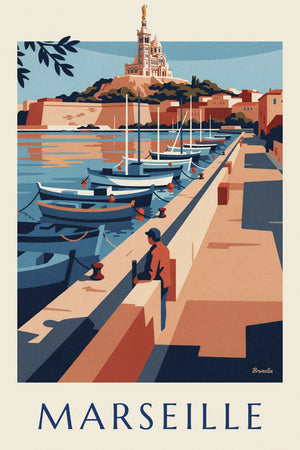
The 20 posters that made history
The 20 posters that made history: Steinlen’s Le Chat Noir, Mucha’s Gismonda, Toulouse-Lautrec’s Moulin Rouge, Cassandre’s L’Étoile du Nord, Rabier’s La Vache qui Rit, Savignac’s Astra. Each with its story, its technique and its graphic lesson.

Key points
- 56 posters in the Art Deco posters collection, the 20 from this article in the table below.
- From 19,95 € in A4, up to 69,95 € in A0, 5 sizes for each poster.
- Printed in Europe on demand, free delivery from 59 €.
The table
The 20 posters at a glance






Over the course of the 20th century, thousands of posters covered the hoardings of Paris. A few have outlived their era. They have become icons recognizable at a glance, displayed in museums and fetching several thousand euros at auction.
Here are 20 of them, in chronological order. Each one carries a lesson: a graphic choice, a revolutionary technique, a simple idea beautifully executed. Understanding why they have lasted means learning to look at every poster differently.
20 posters that defined a century of illustration
Some posters have become more than advertising images: they are cultural icons, recognizable at a glance. Here are 20 posters that made the history of French and international illustration, from the Belle Époque to the 1960s.
For each one, the artist, the year, and what makes it a classic. Many of them still inspire contemporary studios today, Brunelia included.
1. Job by Alphonse Mucha (1896)
The poster for Job cigarette papers established Mucha as the master of Art Nouveau. Stylized wavy hair, a golden palette, an arabesque composition. The model that defined modern commercial illustration.
2. La Goulue by Toulouse-Lautrec (1891)
A poster for the Moulin Rouge featuring the dancer La Goulue. The first of its kind to use bold flat areas of color and photographic framing. A lasting influence on graphic design.
3. Étoile du Nord by Cassandre (1927)
A poster for the Nord railways. A minimalist composition: rails converge toward a stylized blue star. Here Cassandre invents the modern poster, geometric and almost abstract.
4. Normandie by Cassandre (1935)
Made for the Compagnie générale transatlantique. The Normandie ocean liner seen head-on, monumental, in an almost Cubist composition. Considered the finest maritime poster of the 20th century.
5. Cassis by Roger Broders (1927)
A PLM poster. A plunging view over the calanques. A palette of terracotta and deep blue. The very signature of the French Riviera aesthetic of the 1920s and 30s.
6. La Côte d’Azur by Roger Broders (1929)
A figure in the foreground, a stylized bay in the background. The invitation-to-travel technique that Broders would perfect across 100 PLM posters.
7. Bonjour Paris by Bernard Villemot (1956)
For Air France. A stylized Eiffel Tower, a pastel palette, modern lettering. It marks the shift from illustration to the graphic design of the postwar boom years (the Trente Glorieuses).
8. Bally by Bernard Villemot (1979)
For Bally shoes. A silhouette of stylized women’s legs against a plain green background. It became the benchmark poster for every French graphic design school.
9. Dubonnet by Cassandre (1932)
3 posters in a series: Du, Dubo, Dubonnet. Sequential graphic storytelling was born with this campaign. Still studied in advertising today.
10. Nicolas by Loupot (1934)
For Nicolas wines. The character Nectar with 10 bottles. He became the commercial icon of an entire generation of French people.
11. Air France by Roger Excoffon (1962)
A stylized seahorse on a blue background. The airline’s visual identity for 30 years. One of the finest syntheses of logo and illustration.
12. Loïe Fuller by Jules Chéret (1893)
The American dancer Loïe Fuller, draped in fabric, suspended mid-movement. Chéret invents the light, airy female figure that would dominate Belle Époque illustration.
13. Le Chat Noir by Théophile Steinlen (1896)
For the Parisian cabaret. A hieratic black cat on an ochre background. Reproduced today on millions of T-shirts and mugs, it has become the ultimate icon of Montmartre’s Paris.
14. Pour la Tour Eiffel by Henri Rivière (1902)
A series of 36 lithographic views of the Eiffel Tower from different angles. It foreshadows Westernized Japanese prints. A major reference for travel illustrators.
15. Mistinguett by Charles Gesmar (1925)
For the Moulin Rouge. A stylized portrait of Mistinguett, in pure Art Deco lines. Art Deco female imagery reaches its peak here.
16. Hyères by Hugo d’Alesi (1908)
For the PLM, before Broders. A stylized aerial view of the palm trees of Hyères. It already announces the French Riviera visual language that Broders would perfect.
17. Wagons-Lits by Cassandre (1934)
For the Compagnie internationale des Wagons-Lits. A Cubist interior view of a night train. One of the finest Art Deco compositions applied to transport.
18. Dunlop by Pierre Fix-Masseau (1935)
For Dunlop tires. A circular tire track on a two-tone background. Car advertising becomes art.
19. Citroën Traction by Robert Falcucci (1934)
For the Citroën Traction. A three-quarter view of the car, in red, black and white. The first example of the French car poster, which would inspire every studio that followed.
20. Mai 68 by the Beaux-Arts (1968)
Anonymous screen-printed posters made in the occupied Beaux-Arts. A minimalist composition, a direct political message. It marks the definitive break between the commercial poster of the past and contemporary graphic design.
These 20 posters define a visual language: flat areas of color, graphic stylization, immediate readability. Contemporary studios, Brunelia among them, still work in this tradition today.
To discover our interpretation of the great PLM destinations, see French Riviera, Provence, French cities. To go further on Roger Broders, read his story.

The poster for this part
Woman in polka dot dress choosing a song at the jukebox poster
from 19,95 €
Build this wall
3 posters from this article, at true scale


All 3 posters: 99,85 €
Frequently asked questions
You often ask us
What is the most iconic French poster?
Hard to choose. 3 references: Bal du Moulin Rouge (Toulouse-Lautrec, 1891), the Normandie ocean liner (Cassandre, 1935), Mont Saint-Michel (Roger Broders, 1932).
Who are the major illustrators of the French poster?
Toulouse-Lautrec, Mucha and Chéret for the Belle Époque. Cassandre, Roger Broders, Paul Colin and Jean Dupas for the 1920s and 30s. Cappiello for food and drink posters.
Which poster should I choose to decorate with an iconic piece?
Choose a single iconic poster in a large A1 size rather than several small ones. An iconic poster commands its subject and doesn’t blend with others.
What is the richest period of the French poster?
The PLM and Art Deco golden age (1920-1940). Cassandre, Roger Broders and Jean Dupas were commissioned by the railway companies to promote destinations.
Can I buy an authentic period poster?
Specialized galleries and auction houses offer antique posters. Check the edition, condition and provenance before comparing prices. A contemporary illustration in a retro style is another decorative option; it should not be confused with an original antique.
Keep exploring